Showing posts with label science. Show all posts

Tuesday, June 26, 2012

Para escribir poesía...


I love this poemita by Francisco X. Alarcón.  Poetry seems to be making a comeback in priority in the classroom probably due to its resurgence on standardized tests.  As this poem indicates, those lessons on the five senses from the early grades will provide the foundation for students to be able to write poetry in the upper grades.

What way have you found to help your students touch, smell, and taste words?

Wednesday, May 16, 2012

Rima, Rima, Rimador...

Rhyming...if you are a PK/K teacher, that very word could strike terror in your soul!  You have probably been working on rhyming all year and now you are administering assessments on your little ones to see if they can generate rhyming words and identify rhyming pairs. 

I am currently preparing a training for a group of PK/K bilingual teachers on how to teach rhyming in Spanish.  EL Saber has a new resource available for teachers called Palabrimas.  The resource is a series of Spanish rhyming activities that give students the opportunity to practice their rhyming skills to become successful readers. 

While I have always known that rhyming was an important skill for literacy, I really didn't know why.  I could see the need for blending syllables...this helps you read words.  I could see the need for segmenting syllables...this helps you write words.  But rhyming?  Besides being fun, why is it considered so foundational, especially for Spanish-speakers and readers who do not rely on word families for decoding?

Well, after spending several hours searching the research journal databases, I found some really good articles and came up with these general recommendations from their studies on Spanish-speaking bilingual learners and rhyming instruction:
·      Developing the skill of rhyming in both languages simultaneously can help students acquire phonological awareness more quickly due to cross-linguistic transfer.
Dickinson, D., McCabe, A., Clark-Chiarelli, N., & Wolf, A. (2004).


·    Spanish-speaking children may require more exposure than their English-speaking peers to acquire rhyming skills.
Culatta, B., Reese, M., & Setzer, L.  (2006). 


·      Be careful when using visual images because of ELLs’ tendency to emphasize meaning over sound.
Moreira, S. & Hamilton, M.  (2006).


·      Target one rhyme per activity (initially) and provide multiple examples of the targeted rhyming words.  Nonsense words may be included but students must understand their purpose.
Culatta, B., Reese, M., & Setzer, L.  (2006). 


·      While teaching rhyme in Spanish is constrained by the limited number of rhyming word pairs available, teachers may compensate by repeatedly using the same word pairs in a large array of meaningful activities.
Culatta, B., Reese, M., & Setzer, L.  (2006). 


·      Anchor students’ understanding of the words rhyme/rima and rhyming words/palabras que riman.  Prior to reading subsequent stories, check for an understanding of what rhyming is and remind the children to listen for words that rhyme.
Adams, M., Foorman, B., Lundberg, I., & Beeler, T. (1998). 


·      Highlight the ending using intonation and stress.  While reading rhyme stories aloud, exaggerate the meter and rhyme to encourage active listening and anticipation among the children.
Culatta, B., Reese, M., & Setzer, L.  (2006). 


In addition to all of these Palabrimas resources, I have found and created a lot of other rhyming activities/games as well as located A LOT of Spanish rhyming books.  I will post more next week!  Until then...¡Hasta mañana, iguana!  

Tuesday, April 24, 2012

Butterflies on my brain: El ciclo de vida de las mariposas

I have had butterflies on the brain lately.  Apparently, there is a park not too far from my home where moms and teachers love to collect milkweed with caterpillar eggs.  Every day on Facebook, I see new pictures of hatching caterpillars and beautiful chrysalises.  So, when I was at the public library last week with my girls and came across this book, Butterflies on Carmen Street/Mariposas en la calle CarmenI had to share it with you because maybe butterflies are on your brain too.
Butterflies on Carmen Street/ Mariposas en la calle Carmen
I have always loved books by this publisher and Monica Brown does an excellent job of embedding the life cycle of a butterfly in a simple, sweet narrative about a girl and her grandfather.  This book would be perfect for first through third grades and probably Kindergarten too at this point in the year.

There are tons of resources out there for English instruction on the butterfly life cycle but I thought I would do a little digging for some Spanish resources.  Here are some Spanish fiction and nonfiction books that look perfect for the primary grades.
Adios, Oscar!: Una fabula de mariposas: (Spanish language edition of Adios, Oscar!) (Spanish Edition)

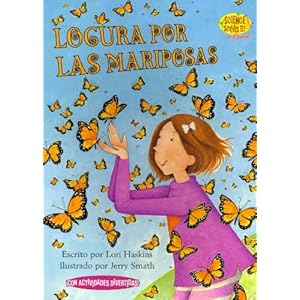
Locura por las mariposas / Butterfly Fever (Science Solves It En Espanol) (Spanish Edition)

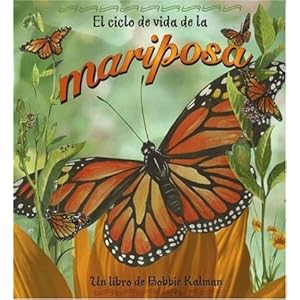
El Ciclo de Vida de la Mariposa = Life Cycle of a Butterfly (Spanish Edition)
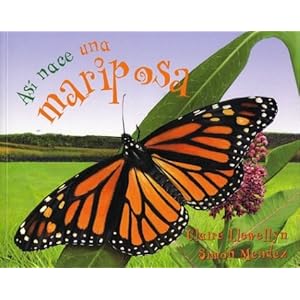
Así nace una mariposa (Starting Life Butterfly) (Asi Nace) (Spanish Edition)
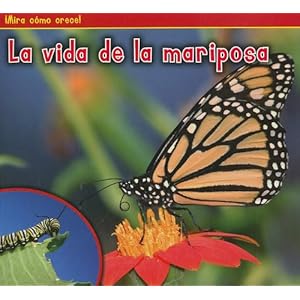
La vida de la mariposa (The Life of a Butterfly) (Mira Como Crece!) (Spanish Edition)

Some other resources from the good ol' WWW:
El ciclo de vida de la mariposa monarca - In both Spanish and English, this site offers a photo slide show with short text explanations for each picture.  It would make a great sequencing activity or could be used to match the text with the appropriate photograph.
Ciclo vital de la mariposa - This site has beautiful pictures of the stages of the life cycle with brief explanations in both Spanish and English.
Mi Escuelita Montessori describes hands-on unit of study on the butterfly's life cycle.


Your students can practice sequencing the stages of the butterfly's life cycle using this Scholastic game in Spanish or English.

And if you just need to see and hear something precious, check out this video about a butterfly's life cycle narrated in Spanish by first graders.

When you are ready to put it all together, you can make this craft by Educarpetas.

And, for you dual language classrooms, here is a perfect GLAD chant in English from a first grade classroom and another song from a second grade class to practice the English vocabulary of the life cycle.

So, are butterflies on your brain this spring?  Please let me know if you use any of these resources or if you find some more that I should add here!

Sunday, April 1, 2012

Making TAREA Work for Everyone

Last night while I was cooking dinner, I overheard the news anchorman say, "We're talking about homework.  How much is too much and is it even necessary at all?"  You can see the video from the broadcast here.  (Updated 8/21/13: The original video is not available but here is a link to a similar report.)
As a teacher, I have never been a huge fan of homework.  It brings up so many questions:  What assignment do I give?  How much do I give?  What horrible thing logical consequence happens to those that do not do their homework?  How do I grade homework?  Do I grade homework?  How much weight do I give the homework grades?

After processing those questions for many years and working through my Masters in Reading where I read lots and lots of research, I developed my own personal philosophy about homework. 
Homework SHOULD NOT be:
- a time where I expect the parents to do the job that I should have done during the school day
- the boring work that I do not want to make time for in my schedule
- an assignment that has never been practiced with my guidance in class
- unexpected and unpredictable
- frustrating for parents, children, and the teacher!

Homework SHOULD be:
- congruent with my beliefs about what good teaching and instruction should look like in my classroom
- a reflection of the learning that we are doing in school
- consistent and predictable so that families can plan for their lives outside of school
- a time for the student and the parent(s) to bond with each other as they talk and learn from each other
- challenging but rewarding for both the parents, children, and the teacher!

Based on this philosophy, I made this weekly homework packet for my second graders.


In class, my students and I kept individual dialogue journals about their reading during self-selected reading time.  "Lectura en casa" was a miniature extension of these journals. 

The entire packet was turned in on Monday mornings and a new packet was sent home on Monday afternoon.  I did not check the packet every day.  Wait a minute!  I know what you're thinking!  What if they just filled in the whole thing over the weekend?  That probably happened but there are only so many things you can control.  I read this article and it confirmed my decision. (Update 8/21/13 - The linked article is now only available to Choice Literacy subscribers.  Sorry!  However, this more recent article by Kathy Collins is excellent!)
While the majority of the writing in our classroom was in a writing workshop format where the students could choose the genre and topic, for "Escritura en casa", I would write a simple prompt that would ideally inspire some discussion at home before writing.  I asked students to tell how they got their name, to share their families' funniest moment, to retell a special memory with a relative, etc.  This was my favorite sheet of the homework packet because it really gave me a window into my students' lives and the anecdotes provided a means for me to build relationships with the parents.  It was amazing how a comment about one of these stories could quickly light the mood at a parent-teacher conference!


Spelling homework!  Ahhhh!  Since I have entered the world of parenthood, I hear more horror stories from my friends with school-aged children about the dreadfulness of spelling homework.  I think spelling is the area of more teacher malpractice than any other subject area but that is a whole other bowl of frijoles!  Anyways, I use the Words Their Way method for spelling during the school day so that spills over into homework.  On Mondays, students sort their Spanish words according to the patterns for that week.  On Tuesday, they do a no-peeking writing sort with the Spanish words.  On Wednesdays and Thursdays, they repeat the process with their English words.  

All in all, it is a pretty painless process and my students' scores on the Friday assessment were much better than they had been when I required things like writing sentences, rainbow spelling, pyramid spelling, alphabetical order, etc.  To all of my former students who were required to do those assignments, please consider this my open letter of apology!  


My math assignments varied throughout the school year.  This page was in the packet for the majority of the first semester while students were working on automaticity with their sums.  During class, we discussed various strategies for visualizing numeracy.  We played several different games and made flashcards.  Students were to use those flashcards as well as playing cards or dice to practice their sums at home.  Embedding the table as an assessment tool was helpful in keeping the parents informed about how well their children really knew the facts.  This is one of those concrete tools that parents really love because they can see progress over time.  I got a lot of good feedback from this page.


Because my total packet was three pages front and back, I alternated between using the Science and the Social Studies pages each week.  Most of the time, I would write a question asking students to apply our unit of study to their lives at home.  I would often find the questions or prompts in the textbook teacher's guides.  The topics were sometimes imaginative (What would it be like today in your house if electricity had never been invented?) or exploratory (Make a list of five items in your house that are attracted to your magnet.).


So, there you have it!  It's not perfect and I will continue tweaking it to make sure that homework is truly purposeful and powerful in bridging learning from school to home.  If you would like to download my homework packet for free, you can do so here.  Let me know what you think!  I would love to know how you make homework work for you in your classroom!

Thursday, March 29, 2012

Science and Songs: Los Planetas

While I took piano lessons for many years, I am not what you would call a natural musician.  Still, I have seen over and over the positive impact that music can have on students' learning.  It has that "Velcro" factor that helps the content stick to the brain.

I spent the summer of 2002 working on staff at Teach for America's summer institute in Houston.  I was amazed by all the ways the Corps Members found to integrate music into the content learning with amazing results.  Ever since, I have been inspired to try it myself.  Below are some examples of the products my bilingual second graders created after a library research study on the planets.  We created "La Tierra" together (to the tune of "La Cucaracha") and then the students worked in small groups to create subsequent verses for their assigned planet.   They had so much fun and were so proud of our song!  It's kind of catchy too!


Posted by Picasa