Showing posts with label classroom. Show all posts

Wednesday, September 26, 2012

Ask the Readers: Transitions & Attention-Getters in Spanish


Last week, I received a question from one of the "I Teach Dual Language" Facebook readers.  In case you aren't on Facebook, I thought I would share it with you!


I'm teaching Kindergarten Spanish for the first time and I need transition songs in Spanish.  Does anyone know some good and easy ones?  Also, I'm used to attention-getters such as 1, 2, 3, eyes on me..."  What can I use for an all Spanish class?  

I reposted this question on my Facebook page and here are the ideas that were shared by all of the AWESOME readers!  Thanks so much to everyone who contributed.  

Attention-Getters

  • Sung to the tune of the Addams Family:  Ojos aquí (snap snap), ojos aquí (snap snap) ojos aquí, ojos aquí (snap snap).  Escucha a tu maestra y pon atención.  Cierra bien la boca y pon los ojos aquí.  Ojos aquí (snap snap)…and repeat to finish the song.  
  • Teacher:  “Respeto.”  Students:  “Tratar a los demás como quieres que te traten.”  While they say the words, their arms go out in front and then across their body (kind of like the Macarena) so that when they finish speaking their arms are crossed and now they aren’t playing with anything, waiting for further instructions.  Like this:  “Tratar (right arm straight out) a los demás (left arm straight out) como quieres (right arm to left shoulder) que te traten (left arm to right shoulder).”
  • Teacher:  Dáme cinco.  Students:  Boca cerrada, miro y escucho (holding up one finger for each word until they were showing 5).
  • Teacher:  Uno, dos, tres, ojos aquí
  • Teacher:  Uno, dos, tres, ojos a mí.  Students:  Uno, dos, tres, ojos a tí
  • Teacher:  ¿Qué te pasa, Calabaza?  Students: Nada, nada, limonada.
  • Teacher:  Hola, hola.  Students:  Coca cola.
  • Teacher:  Si escuchas mi voz, aplaude dos veces.  Si escuchas mi voz, aplaude tres veces.
  • Teacher:  Uno, dos, tres, mírame otra vez.
  • Teacher:  Uno, dos, tres.  Students:  A la vez.
  • Teacher:  ¡Clase!  ¡Clase!  Students:  ¡Sí!  ¡Sí!
  • Teacher:  Atención.  Pon atención.  Abre los ojos mirando hacia acá.
Transitions

I LOVE all of these suggestions!  If you have more, please share in the comments below.  Thanks again to everyone that shared their ideas!

Thursday, August 30, 2012

Esperanzas y expectativas Linky Party

Have you ever created a chart similar to this one?

FYI, these charts are not mine.  If you are a MISD teacher and you recognize your chart, please let me know and I will be happy to give you credit!  

These are all charts that I have photographed during first week of school visits over the past several years.  


Whether you are a first year teacher or an experienced teacher, it is always helpful to have the opportunity to peek into others' classrooms and get some ideas.  If you would be willing to let us see your Esperanzas y expectativas (aka "Reglas" o "Normas"), please link up with us here!  Thanks so much for sharing!

Wednesday, July 25, 2012

Instead of "I don't know"

Okay, before you read any further, please go read this article over at ReadingRockets.org.  

If you read the article (PLEASE tell me you did!), you read this important paragraph:
Essentially, teachers can elicit more from the less proficient or reticent students if they consider various response options and then enlarge their response repertoires in order to encourage students' participation and help develop their language proficiencies.

Another favorite paragraph from the article says this:
An important distinction made by Cazden (2001) is that teachers are responsible for both the affective and academic aspects of effective classrooms and classroom talk. Teachers can direct classroom discourse so that both these goals are targeted and supported. For example, teachers can accept, deny, recast, expand, or encourage elaboration of students' responses. "Success for students in culturally diverse classrooms depends on the degree to which there are strategies that encourage all students to talk and work together" (DeVillar & Faltis, 1991). 

As we think of starting a new school year, I think one of the best supports we can provide students is a way to communicate if they need help or more support.  If you are a Texas teacher rating students with the TELPAS, you know that one of the criteria to move up listening proficiency levels is the ability to ask the speaker to repeat, slow down, rephrase, or clarify.  

Some time during the first week of school, ask your students to brainstorm with you a list of ways to request help.  Post the charts at their eye level at your meeting rug so they can be referred to as needed.  Role play their use together so that even non-readers will be able to use them when they need to.  

As the article states, we as teachers often let the "silent period" last too long.  When we do that, we begin to unintentionally communicate to the silent ones that we think they really have nothing worthy saying.  The very beginning of the school year is the perfect time to establish a classroom culture of valuing each student's voice!

I would love to see the posters you brainstorm with your students!  Feel free to leave a link in the comments below so that we can get more ideas from you!

Friday, July 6, 2012

Daily Five & Dual Language???

I first read The Daily Five in the summer of 2006.  I had just finished my Masters in Reading and was ready to implement all sorts of new ideas.  I loved the book and spent June and July dreaming up ways to rearrange my classroom.  I even bought a super ugly but comfy chair off of Craigslist.  My husband thought the guy should have paid us to take it from him instead of vice-versa but I knew my students would love it.  August came and I was asked to leave my classroom and work as the bilingual facilitator for my district.  While I was excited about my new job, I was sad to leave my dreams for my classroom behind and sad to not have the opportunity to implement the Daily Five with my own students.

From all of the teacher blogs that I visit, the Daily Five is still very much alive!  How's that for a rhyme?  This past fall, while I was coaching in another school district, I found this Kinder teacher beginning implementation of the Daily Five with her little ones.  These pictures were taken on September 20th.  I think that is impressive!


In the past few weeks, I have come across these bilingual blogs with resources and thoughts about implementing the Daily 5 in both Spanish and English:

Have you written a post about implementing the Daily 5 in your bilingual or dual classroom?  Please leave me a comment here and I will add you to my list!

Thursday, March 15, 2012

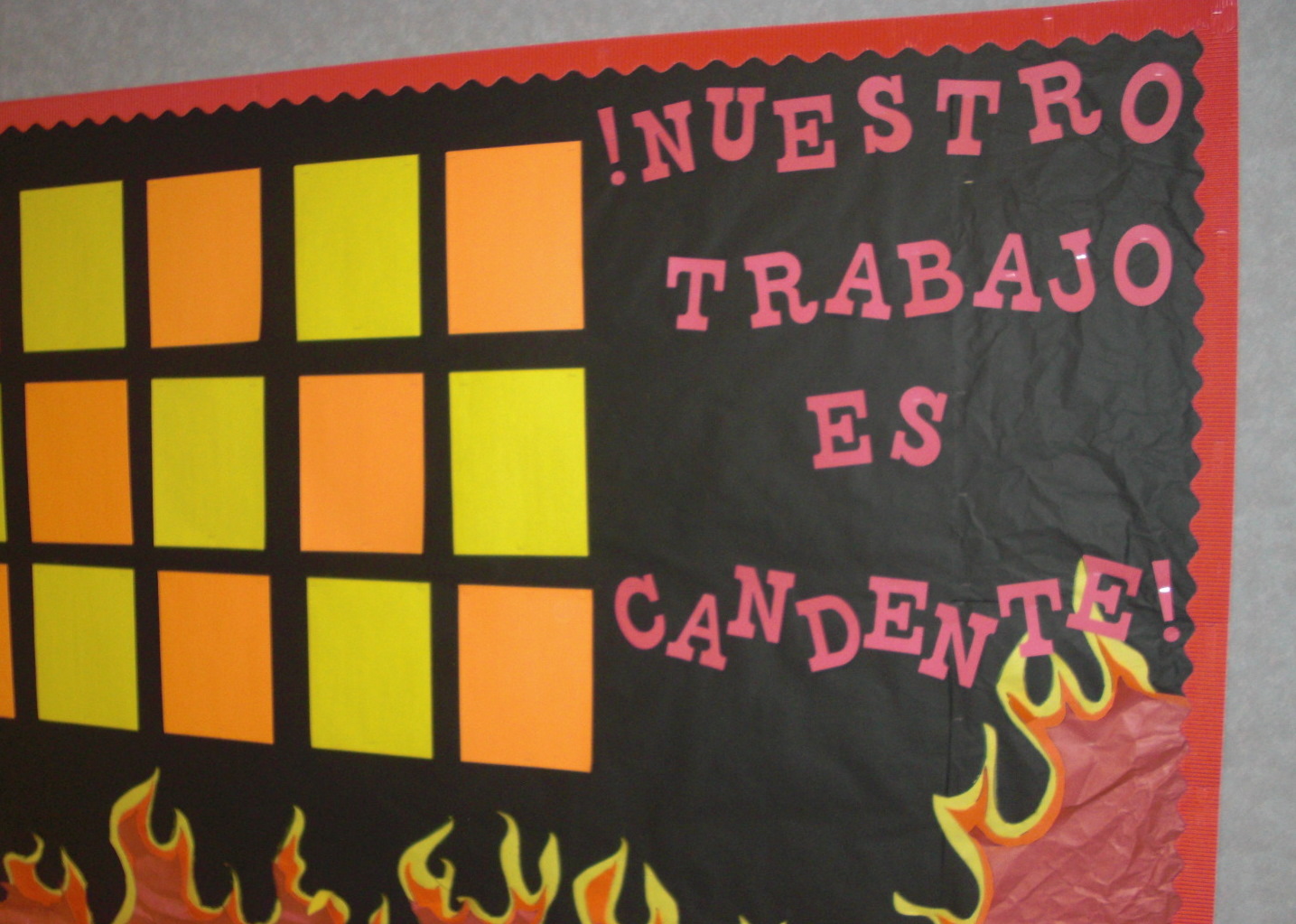
Bulletin Boards: You are SO Punny!

Spanish is not my first language.  Of all of the things that could stress me out as a teacher teaching in a second language, what was at the very top of my list?  BULLETIN BOARDS!  Not only was I expected to write something grammatically correct and spelled correctly, I wanted it to be CUTE and funny like all of the monolingual bulletin boards down my hall.

I will never forget the very first bulletin board outside my first classroom.  The entire second grade made shape bears as a part of the first week of school activities.  In preparation for parent information night, all of the monolingual teachers had written variations of bear puns like "We are BEAR-Y excited to be in 2nd Grade!"  I knew that would have no meaning for the parents of my students but I had no clue what to write in Spanish.

On my drive home from school one night, I had an idea.  I'm convinced it was divine intervention because I am just not that punny even in my native English.  The phrase that came to me on the highway that night was:  ¡Somos maravill-OSOS!   It was my first pun in Spanish and I was SO proud!

Since the springtime is often a time for Open Houses and sprucing up the ol' bulletin board, I thought you might like to see some boards that I have seen in my visits to lots of different campuses.  Most of these photos were taken at the beginning of the year so that explains why there is no student work up yet.  Use an idea now or pin it to remember at the start of next year!


Do you have a beautiful bilingual bulletin board (that is some serious alliteration!) you would like to share?  Please post your link here so we can take a look!
Posted by Picasa

Monday, January 30, 2012

What's the Language of the Day?

There are so many interpretations of the term "dual-language education". Depending on the model to which your district or campus subscribes, you may be responsible for the instruction of one language for all subjects throughout an entire day or for specific subjects every day. However, due to lack of qualified personnel or a multitude of other reasons, YOU may be it! You may be responsible for instruction in both languages according to the day or subject, depending on the model.

If you have had any experience in this context, you know that it can be confusing both for you and your students. The question, "What language are we speaking?" can often be heard and just might be something you have asked yourself!

While it can be difficult to make the switch between the two languages, it is not impossible. One thing we know is that students respond to context and that response can trigger an appropriate reaction in their brains. For example, I am a tall (6' 1") Anglo woman. When I am consulting on a campus, I try very hard to observe and converse with students without disrupting the classroom environment. Yet, my skin and height make that a bit of a challenge! I find it interesting though that even Pre-K and Kindergarten children will automatically switch from Spanish to English when I bend down to observe their work. Since they have never heard me speak, they are using visual context to determine the best form of communication.

So, as dual-language teachers, our question should be, "How can we create contexts which indicate a shift from one language to the other?" It might be a visual sign that we flip and read aloud (see the four examples below).


I have seen primary teachers use different stuffed animals or puppets to quickly intro the switch. Others play a particular song or CD indicating the transition. What other ideas have you tried to create a context for switching the language of instruction?

Tuesday, January 17, 2012

Bilingual Word Walls...Worth the Space?

Word walls...you either love them or you hate them! They are kind of like a pet. They require lots of care and maintenance and long-term commitment. The question is: Do word walls provide enough return on your investment? This is an especially key question for the bilingual and dual-language teacher because, in order to maintain a balanced language environment, it will be necessary to have TWO word walls.

Here are some pictures that I have taken over the years as I have visited various dual-language classrooms (the last two were taken at the very beginning of the year so no words had been added yet!):


I have had word walls up in my classroom every year that I have taught. However, during my first few years of teaching, I put all of the words up at once and hoped that my students would internalize the reading and spelling of these highly-frequent words by simply having them present in the room. Occasionally, when a student asked how to spell a word, I would point him to the word wall and say, "Well, it's on the wall!" and send him off to search. It was rarely a fruitful search and I began to question the point of a word wall.

I began my sixth year of teaching in a new district that placed a high priority on word walls. Before the school year began, I sat in a two-day training on Balanced Literacy and heard continuously about how the word wall was to be one of the anchors for my reading and writing throughout the day. I learned that I should choose just a few words each week to add to the wall. Every day, I should review those words, connect how those words might help us write other words, and discuss my encounters with those words during my shared reading and shared writing.

As school started, I began putting into practice my new learning about word walls and I was amazed. The more I interacted with the word wall, the more my second-grade students began to use it in their reading and writing. We would spend about five minutes every day (two days in Spanish and two days in English) studying the newly added words as well as the previous words. We chanted the words, wrote them on dry-erase boards, and played various brief games to continue to familiarize the students with the words and their locations. Throughout the rest of the day, word wall words continued to magically appear as we read during guided reading or in the content areas. As we wrote, we found that those same word wall words were incredibly necessary to practically anything we wanted to write.

So, yes, I believe word walls are worth the space. I especially believe they are worth the space in dual-language classrooms. As my supervisor often used to say, "Dual-language education is an enrichment program, not a remedial program." Our students are learning twice the amount of words in the same amount of time as the general education classroom learns one. Word walls provide an organizational structure of support for our students as they take on this challenging task.

All of the pictures above were taken from a district that required red to be associated with the Spanish word wall and blue to be associated with the English word wall. In one of my favorite articles about bilingual education, Samina Hadi-Tabassum writes "Learners more easily become bilingual when they connect each language to a separate context." In her article "The Balancing Act of Bilingual Immersion" in Educational Leadership (Dec. 2004/Jan 2005), she discusses different ways to separate languages for instructional purposes while at the same time encouraging students to consider mediation and transference between the two (or more) langauges. Having separate word walls that are organized similiarly helps to do that. Young students can begin to see that they must turn to the English word wall when writing a piece in English. Yet, they can also notice that, while both word walls are organized in the same fashion, the Spanish wall has letters which the English wall does not.

If you feel your word walls are more wallpaper than instructional aids, consider whether you are making a big enough deal about them. Yes, they do require daily care and maintenance, but they can become a second-teacher in your classroom for your students. Can you really put a price on that?