Showing posts with label biliteracy transfer. Show all posts

Wednesday, November 28, 2012

Explorar las expectativas: Blending phonemes & syllables

Forget political parties or topics of religion.  If you really want to start a heated discussion at a gathering of bilingual teachers, bring up the topic of blending syllables versus phonemes in Spanish!

I won't even pretend to be able to address this topic comprehensively on my humble little blog but, based on what I have learned over the years from experts on biliteracy, here are some thoughts on teaching the expectations listed below:  

Beginning Reading Skills/Phonological Awareness
KINDERGARTEN
Spanish Language Arts and Reading TEKS:  2(F) blend spoken phonemes to form syllables and words (e.g., /m/ … /a/ says ma, ma-pa says “mapa”)
English Language Arts and Reading TEKS:  2(G) blend spoken phonemes to form one-syllable 
words (e.g. /m/…/a/.../n/ says man)


FIRST GRADE
Spanish Language Arts and Reading TEKS:  2(C) blend spoken phonemes to form syllables and 
words (e.g., sol, pato); 
English Language Arts and Reading TEKS:  2(D) blend spoken phonemes to form one- and two syllable words, including consonant blends (e.g., spr)


  • Spanish is a syllabic language with the majority of its words composed on open syllables (syllables ending with a vowel such as ca + mi + sa).  There are 117 open syllables in Spanish.  You can download a great assessment freebie from Claudia with all of these syllables here.  When a child has mastery of those 117 syllables, he has unlocked the basic code of Spanish reading.  
  • There is no true Spanish equivalent for the English word family (-ad, -et, -op, -ug, etc.) but the Spanish syllable is typically introduced in a developmentally equivalent order.  Just as students are introduced to English word families once they have begun to master letter sounds, Spanish speakers are introduced to syllables as soon as they have a grasp on initial sounds.
  • As is stated in the Kindergarten TEKS 2F above, blending the Spanish syllable is usually taught something like /m/.../a/ dice ma.../p/.../a/ dice pa...mapa.  Blending English phonemes in early CVC words would go like /c/../a/.../t/...says cat.
  • Since the Spanish syllables are so consistent and few (117 is a relatively small number when compared to the variety of craziness with the English language), early Spanish readers are more fluent and successful when they read ma as a syllabic unit rather than as two distinct phonemes.  
  • In bilingual and dual language education, early Spanish readers will eventually become English readers.  As teachers plan instruction for transfer, it is important that we prepare our students to be flexible with sounds.  While we would first teach students to blend and segment words at the syllable level (ca-mi-sa), we do want them to be aware of the individual sounds and letters that comprise those syllables if we were to stretch the words even further (c-a-m-i-s-a).  
  • Lucy Caulkins talks about stretching the words like a rubber band to hear all of the sounds.  When we move from syllables to phonemes, it is as if we are just stretching the rubber band even further.  Again, my recommendation is that this second level of stretching only occurs once students have mastered blending and segmenting at the syllable level.
When it comes to activities for teaching these expectations, here are some resources to get you started:
  • These are some examples of simple flip charts to help students practice blending syllables:


So...what are your thoughts about blending syllables versus phonemes?  How you do help accelerate your students' mastery of blending syllables in Spanish?  


Wednesday, August 8, 2012

The Guided Reading Dilemma

During my first year of teaching in a one-way dual language program, I had the ambitious goal of doing guided reading with all of my students in both languages.  I carefully assessed my students' levels in Spanish and English and then organized six Spanish groups and six English groups.  On Mondays and Tuesdays (Spanish days), I would meet with as many of my Spanish groups as possible and then on Wednesdays and Thursdays, I would try to meet with all of the students again in their English groups.  Crazy, loco, insane in the membrane!!!

My English groups did not necessarily mirror the Spanish groups.  This made for many complications when I would call groups.  Juan would come up with Valeria but then we would remember that he was only in her Spanish group but not her English group.  I ended up meeting with my highest groups so infrequently that we rarely finished a book in either language.  

Guided reading became one big headache!  

That spring and summer, I was working on my Masters in Reading.  The more I read, the more I was convinced that I needed to resolve my guided reading issues.  In order to do the kind of guided reading instruction that I was reading about in my classes, I felt that I needed to focus my small group instruction on one language.  

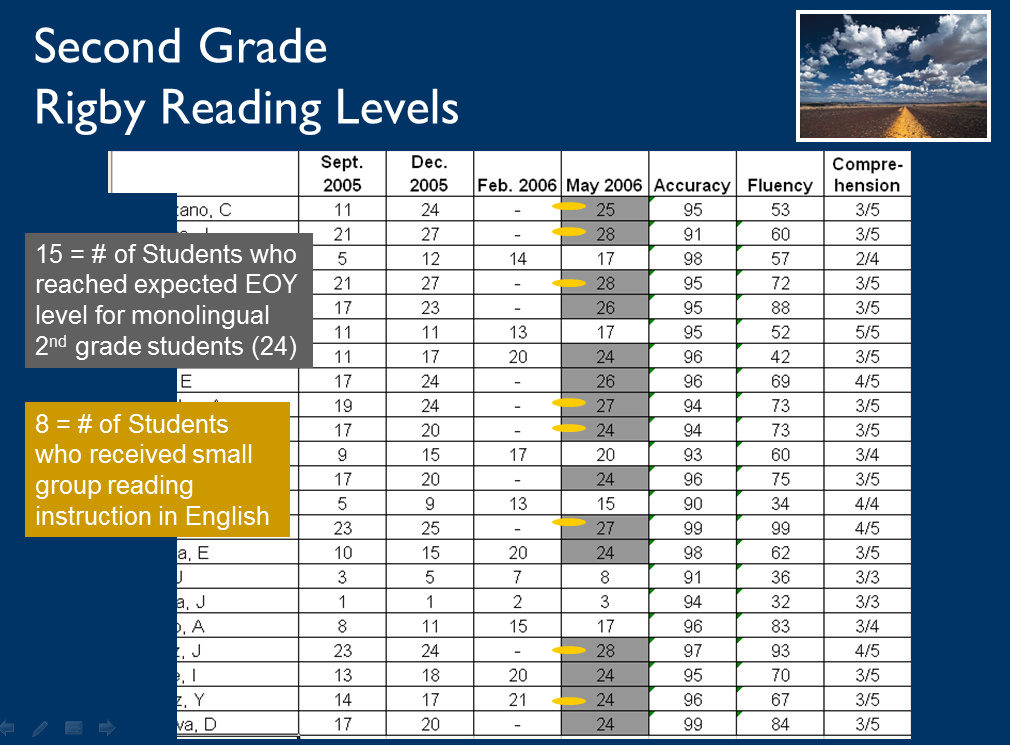
As I began my second year, I had a new plan.  Using my district's "Guidelines for On Level Reading Performance" (below), I examined my students' Spanish reading levels.  Any student who already met the Spanish expectation for the end of second grade became a candidate for small group instruction in English.  The rest of the students received small group instruction focused in Spanish.


Every six weeks, I would assess my students' levels in Spanish and rearrange my groups.  The Reading Specialist on my campus would assess my students' English levels and supply me with their results (see chart below).

By the end of the spring semester, 8 of the students were receiving small group instruction in English and 14 were receiving small group instruction in Spanish.  So...imagine my surprise when the Reading Specialist showed up at my classroom door in May to tell me that 15 of my 22 students had tested at the expected end of year level for monolingual English students.  

But I had only done small group guided reading with 8 of those 15!  What happened?  

Biliteracy transfer, my friend.  Biliteracy transfer!

The research from Dr. Kathy Escamilla's Project Literacy Squared says:  "Learning to read first in Spanish when combined with oral proficiency in English is the best predictor of success in English literacy for second language learners." 

Isn't it nice when we can actually see the research play out in our classroom?  While I was strategically working on developing reading strategies and behaviors in their native language, we were also building oral language in English during whole class instruction on English days (50% of our week).  That combination proved to accelerate my students' English levels even when I wasn't doing guided reading with them in that language.  

Please know that I share this info not to brag about my scores!!!  I still have so much to learn and want to do better.  However, I read many of your comments  regarding the challenges of guided reading in our Fountas & Pinnell Spanish Literacy Resources Giveaway and I wanted to share my experience.  I have seen this same data duplicated over and over again in the classrooms of other teachers that have tried out similar methods.  

What are other ways that you have simplified your guided reading and seen positive results?

Friday, July 20, 2012

A Late July Pep Talk

As you spend these last weeks of summer browsing Pinterest and cutting out laminating on your living room floor, I thought I would share a bite of research I recently read about long-term crosslinguistic transfer of skills from the first language (L1) to the second language (L2).


There are several implications that can be drawn from this study. First,students’ early L1 skills appear to play a role in individual differences for L2 learning even several years after students have mastered their L1. In recent years, L2 educators have proposed several hypotheses to account for students’ L2 learning differences (e.g., high anxiety, low motivation, poor use of language learning strategies). However, the results of this study suggest that a large part of the differences on L2 proficiency measures displayed by L2 learners is likely to be explained by their L1 skills. L2 educators should consider the role that L1 plays in learning a L2.


Fifth, because both L2 aptitude and subsequent L2 proficiency appear to be strongly related to early L1 skills, it is important for all educators to know that early L1 language development prior to entering school is important for later L2 learning several years after students have mastered their L1. Likewise, all L1 and L2 educators should understand that mastery of L1 literacy skills in the primary school years is important for students attempting to learn a L2 several years after learning to read their L1. 

The above paragraphs were taken from the Conclusions section of this thesis that looked at the long term impact of crosslinguistic transfer with bilingual students.  


What you bilingual elementary teachers do in the early grades to help your students master their first language truly does pay off in the later grades!  I am currently working on a training for several school districts about best practices for promoting this type of transfer.  I will be sharing what I learn here in coming months.  Like my logo?  :)


Tuesday, June 5, 2012

Talking Rhyme with Dallas ISD

Today, thanks to the Warren Instructional Network, I had the privilege of spending the afternoon with a room full of PK-2 bilingual teachers from Dallas ISD.  As a Dallas resident, I loved getting to meet these teachers and see their passion for improving education for their students.  Our room got a little too full so I promised those that were turned away that I would post some of the resources shared here.

We kicked off our discussion on rhyming by first looking at some quotes from the Introduction to the Spanish Language Arts and Reading TEKS.  Can I just say that these make me so proud to be a Texan?  If you don't believe that these are actually written in our educational law, you can read them yourself right here!

In the interest of vertical team building, check out the importance of rhyming in these SLAR TEKS for grades 3-5 below.  Upper grade teachers, I know you appreciate primary grade teachers that help students develop their ability to distinguish rhyming words AND generate rhymes.  Those abilities will definitely be necessary for analyzing and writing poems!

Check out this Online Spanish Rhyming Dictionary for an excellent resource for creating lists of rhyming words for games and activities.
 Here is a list of some rhyming storybooks for anchoring students' understanding of rhyming:


These are wonderful books full of Spanish poetry for helping students appreciate rhythm and rhyme:


We played two HIGHLY competitive rounds of ¡Basta con las sílabas! where teachers had one minute to generate rhyming words with the endings listed on the game board.  When the timer sounded, participants shared their words with their group.  Every person that had a unique word received a point for his/her word.  If someone else in the group had the same word, neither person received a point.  I loved listening in to the conversations about different words!  This is such a fun, authentic activity for promoting rhyming and vocabulary development!  You can download my game board here for free!


I have previously blogged about the other games and activities that were shared today.  You can view all of ITDL's rhyming posts at this link: http://www.iteachduallanguage.blogspot.com/search/label/rhyming

Thanks again to the DISD teachers for a wonderful afternoon!  Please let me know if there is anything else that I promised you that I have forgotten here.

Stay tuned for a giveaway of a set of five Spanish poetry books from Warren Instructional Network and Booksource.  Details will be posted tomorrow morning!

Wednesday, April 25, 2012

Why I give the Estrellita Accelerated Reading Program a Gold Star!

Throughout my first seven years of teaching in second and third grade, I continuously returned to my Estrellita materials every time I received a student who had not yet cracked the code of reading in Spanish.  I found its unique method to be the most efficient and effective in moving those students from learning letter sounds to blending syllables to decoding and writing polysyllabic words.  

When I began writing curriculum for my school district six years ago, I met with other experienced bilingual primary teachers to discuss the best resources and methods that should be included.  Many of these teachers were native Spanish-speakers that had received their initial literacy education in Peru, Argentina, Mexico, and Columbia.  As we looked at different methods about teaching Spanish reading, we had many arguments discussions about the best way.  We kept coming back to the question about which was better:  ma-me-mi-mo-mu or ma-pa-sa-la?  

We decided to email Estrellita with our question and, shortly after, my phone rang.  Karen Meyer, the author of Estrellita, was on the phone.  I felt like I was talking with a celebrity!  As Karen explained the rationale of her program, we all began to understand why Estrellita was so uniquely effective with our bilingual students in the US.  

Unlike a primary student in a native Spanish-speaking country, most of the students that enroll in PK and Kindergarten bilingual programs in the US are simultaneous bilinguals.  While Spanish is their primary and dominant language, they have been exposed to English phonics through television, educational toys, etc.  So, when you ask a bilingual four-year old about the sound of the letter “A”, who knows what sound he may provide?  

Traditional Spanish reading programs move quickly through the vowels and focus on blending with one consonant at a time.  Estrellita takes into account the potential vowel confusion that can occur with simultaneous bilinguals and focuses initially on mastery of the vowels and blending one vowel with a variety of consonants.  Since there is transfer between the majority the consonants, I have seen my struggling students struggle less with this method than with the ma-me-mi-mo-mu method.  

I can honestly say that I have yet to work with a student who has not been able to learn letter sounds and blend syllables when I consistently used the Estrellita method.  It is systematic and it works and provides the perfect springboard for moving your students along in their journey of reading!

This week, we are featuring a giveaway of one of Estrellita's resources for allowing students to practice the program at home.  The giveaway closes on Friday afternoon.  Find out more information here!


Monday, April 23, 2012

Giveaway: Estrellita Reading Resource

If you have been a bilingual teacher for any amount of time, you have surely heard of Estrellita.  Created by a bilingual teacher for bilingual teachers, Estrellita has been around for over twenty years.  I was first introduced to this accelerated beginning Spanish reading program in 1999 when I was student-teaching in a first grade bilingual classroom in West Chicago.  

While Estrellita has long been a mainstay in the bilingual Spanish classroom, it is now becoming a valued resource in the Dual-Language classroom for teaching Spanish literacy to non-Spanish speakers.  For an excellent explanation of the similarities and differences in English and Spanish literacy, check out this article by Estrellita's author Karen Meyer titled Supporting Early Spanish Literacy in Dual Language Classrooms.  

Because I love this program so much (I will share my reasons later this week), I contacted them to ask about sharing one of their resources with you.  I am receiving no compensation other than the pure joy of giving rather than receiving!  :)  

The wonderful people at Estrellita are offering you their English Parent Packet (value of $44) that is a supplement for the K-1 Beginning Reading Program.  If you already have the K-1 Program, you should have the Parent Packet in Spanish.  This English supplement contains English instructions for the English dominant parents of students in Dual Language programs.  

So would you like to win this resource?  Here is how you can increase your chances with up to four entries (one comment per entry):


  • Become a follower of I Teach Dual Language (see the right margin of this blog) and leave a comment here that you did or that you had already joined.
  • Do you use Estrellita in your classroom?  Leave a comment on Estrellita's Facebook page telling them how it has helped your students.  Leave comment here that you did.
Anonymous entries cannot win because, well, that makes announcing the winner a bit difficult!  The giveaway will close at 5pm CST on Friday, April 27th and the winner will be announced by 9pm.  Good luck!  ¡Buena suerte!

Monday, April 16, 2012

Novelty & Responding to Reading

I just bought a $3 shirt from Target and I can't wait to wear it tomorrow.  It's really not that special but it's NEW to me.  Don't you just love novelty?  The smallest new thing can brighten our days. 

Kids love novelty!  If you need a novel way to get them writing about their reading, try using your chart paper in this way.  Spread the paper across the table of desks and each student gets a quadrant and a marker to write with.  We wrote about text-to-self connections earlier in the week in Spanish and then used the same format to write later in the week in English.  I have always found that it is helpful to repeat the format but change the text when switching from one language to the other within the same week.  While novelty is a good tool, some amount of familiarity sure helps keep that affective filter low!
 
Do you have a good idea for adding some novelty at this point in the school year?
Posted by Picasa

Thursday, March 22, 2012

Learning Disabilities and Cross-Linguistic Transfer

Don't forget to enter to win this week's awesome giveaway!

Do some of your students struggle with learning in two languages more than others?  Have you found little information and support on your campus for understanding how to best meet the needs of these students?

The author of our giveaway resource for this week is Dr. Elsa  Cárdenas-Hagan.  She is a speech pathologist as well as a well-known researcher and author in the field of bilingual education and cross-linguistic transfer.  Colorín Colorado interviews Dr. Cárdenas-Hagan in this webcast about English Language Learners with Disabilities.  It is loaded with excellent information!  It would be an awesome mini staff development for your planning time or a meeting with the other bilingual or dual-language teachers on your campus.  Discussion questions and a handout are included here.


Monday, March 19, 2012

GIVEAWAY: Words of our World (WOW) Vocabulary Program


The summer before my senior year of college, I spent two months studying Spanish in Spain.  Afterwards, my brother met me for two wonderful weeks of travel in Italy.  As we visited museums and cathedrals, I was amazed by how I could read practically anything in Italian with fairly good comprehension because of its similarity to Spanish.  My brother, who had studied French, was able to do the same thing.  At the time, I had never heard the word cognates but I quickly learned how useful they were in understanding another Latin-based language. 

In the years since, I continue to learn how cognates not only help us make sense of a second or third language, they deepen our understanding of our first language as we make connections between words.  Did you know that over 90% of English words of two or more syllables are of Greek or Latin origin?  If we truly want to help our students develop a stronger vocabulary, we must help them deepen their knowledge about words.

Guess what?  We have the perfect resource to help you do that and, are you ready for this, IT WAS MADE JUST FOR YOU!  It is a vocabulary program designed with the intention of building word knowledge in both Spanish and English.  

Dr. Elsa Cárdenas-Hagan of the Valley Speech Language and Learning Center is the developer of the Words of our World (WOW) vocabulary program and she recently posted here about Vocabulary Development for English learners.  

From the Valley Speech website:
Words of our World (WOW) is a vocabulary program which addresses the use of cognates and common roots in Spanish and English to further develop word knowledge.  Students in bilingual and/or dual language programs can benefit from this program.  Students who are interested in learning Spanish can use their knowledge of English to develop Spanish vocabulary.  

Would you like to win the WOW program for your classroom?  Here is how you can increase your chances with up to five entries (one comment per entry):
  • Become a follower of I Teach Dual Language (see the right margin of this blog) and leave a comment that you did or that you had already joined.
  • Visit Valley Speech and Learning Center's website and explore their products.  Leave a comment here telling them which products would be the most useful in your classroom.
  • "Like" EL Saber Enterprises on Facebook and leave a comment that you did.
  • Blog about this giveaway and leave the link here OR send an email about the giveaway to at least five other teachers and copy me in your email (cgrover@elsaberenterprises.com).  Of course, leave a comment here so you get credit!
  • Read Dr. Cárdenas-Hagan's guest post at Vocabulogic, leave a comment there, and leave a comment here telling us that you did.
Anonymous entries cannot win because, well, that makes announcing the winner a bit difficult!  Make sure you leave your email so that I can contact you if you win!  The giveaway will close at 12pm CST on Friday, March 23rd and the winner will be announced at 3pm.  Good luck!  ¡Buena suerte!

If you would like to read even more about using cognates in your classroom, check out a previous ITDL post titled Becoming Cognizant about Cognates.  

Friday, March 9, 2012

Literacy Lesson: El viejo y su puerta (Minimal Pairs)


Are you at the time of year when you and your students could really use a laugh?  You cannot read this book and keep from cracking up!  I love Gary Soto's sense of humor and the great thing about this book is that even first and second graders can "get" the funny parts.
El Viejo y Su Puerta [SPA-VIEJO Y SU PUERTA] [Spanish Edition]
This book provides a great entry to talking about minimal pairs (pares mínimos) with your students.  Minimal pairs are pairs of words which differ in only one phonological element and have distinct meanings.  

In El viejo y su puerta, the old man is not very good at listening to his wife so when she asks him to not forget to bring the puerCa to the barbacoa, he mistakenly hears puerTa.  The old man is a bit confused but the door proves useful en route to the party and there is plenty of food to eat thanks to the friends he makes along the way.  The book begins with this explanation:

En México hay una cancioncita que dice “La puerta.  La puerca.  Al viejo lo mismo le da.”  Eso es porque a un viejo las dos palabras le suenan muy parecidas – sobre todo si no escucha con atención.  Así es que sean jóvenes o viejos, escuchen atentamente porque si no, ¡se pueden meter en un lío!

After you read and enjoy the book, you can have a discussion about minimal pairs and the importance of careful listening using these cards (you can download them for free over at Teachers Pay Teachers):


You can represent the sounds in the words with magnetic letters or by simply writing the letters in the sound boxes.

It is really important to help our students understand minimal pairs in Spanish so that we can better help them understand minimal pairs in English.  Several years ago, I attended a PASA Conference and heard Dr. Elena Izquierdo talk about why our students struggle with English words like "meat" and "mitt".  She said we really need to do a lot more work in the younger grades to train their ears to distinguish the differences.  

What do you think?  Do you have a favorite way to train those little ears?

Wednesday, February 22, 2012

Spelling & the Bilingual Learner

Don't forget about our giveaway of Blooming Writers/El escritor floreciente! You can submit comments until noon CST this Friday!

I received this note a couple of years ago from one of my former second-graders. At the time, he was in sixth grade and had been in US schools for five years.

I was DELIGHTED to hear from this very sweet and smart young man! The first few times that I read the note, I simply focused on the meaning:

To Miss Grover
How are you? Remember when I used to read Green Eggs and Ham. I would like to see you really soon. Oh, and I'm still really organized. I still want to meet Amity [my daughter].
Sincerely, [student's name].


Gradually, my attention turned from the meaning to the mechanics as I realized that this was not a note from a second-grader. This was a note from a middle-schooler and one that had been one of my brightest students in second grade. There were some errors that jumped off the page because they are not age-appropriate for a typical 12-year-old:

- justo - We find this type of error cute when reading the writing of primary students. Yet, I can guess that a typical middle-school English teacher or any other content teacher is not going to have a clue what Juan meant with this word. I would love to see more samples of his writing to see if this is an error that appears often or if this was a one time slip.

- orgonaizde - A primary teacher would give this error a lot of credit for getting in most of the sounds. But, again, would someone who is not accustomed to reading the writing of an ELL be able to read this word? What makes me the saddest is that he failed to use his #1 resource, his native language, to help him spell this word. If he had used the cognate organizado and simply changed the last letter, he would have spelled the word perfectly!

-sensirly - Here is another example of failing to use that native language as a resource. If he would have used sinceramente and understood that -mente is usually the equivalent suffix of -ly, he could have come so much closer to the correct spelling.

Please understand that I am NOT criticizing Juan nor am I criticizing his sixth grade teacher. If anything, I want to go back and have words with his second grade teacher!!! :) This note was a wake-up call for me that we have to do a better job teaching spelling to our bilingual learners. Being biliterate should be an asset to spelling instead of a hindrance but we have to teach students how to use what they know. Too often, our spelling instruction remains compartmentalized within each language.

Next Wednesday, we are going to start a series about improving spelling for our bilingual students. Stay tuned for free printables and lessons in Spanish and English!

Friday, February 17, 2012

NABE Demo of Blooming Writers

I had a great time at my very first NABE conference and it was a privilege to meet lots of dual-language and bilingual teachers.  Thanks so much to those of you that came to our demo of EL Saber's newest resource Blooming Writers/El escritor Floreciente.  That was a new experience for me to be broadcast via microphone throughout the exhibit hall but your warm, smiling faces eased my nerves a lot!

Below is a written version of my talk along with pictures of the charts that were shared.


Who has a green thumb?  If you were to pass by my house on a regular basis, you would know that neither my husband nor I have a green thumb but we really like to have a pretty yard with pretty plants.  We spend a lot of money every few months buying new plants and they do look beautiful for a week or so.  Yet it never fails!  A couple of weeks later, the plants start to droop and the flowers fade and we forget to water or generally care for the plants and eventually it is ugly once again and we plan another trip to the nursery.  Often, while at the nursery, we will call my dad for recommendations.  My dad has a green thumb and has always had a beautiful yard year round.  I used to think that having a “green thumb” meant that you were blessed with a secret “golden touch” that magically kept your plants alive and in bloom.  It has recently dawned on me that the reason that my dad’s yard always looks so beautiful is not because of secret powers but because he is a student of plants.  When he goes outside on Saturdays to “work in the yard”, he doesn’t set out to create a perfect end product and be done.  Instead, he uses what he knows about seasons, soil, and shade to make decisions.  At the same time, he always allows himself the freedom to try out some new things.  One time, after a visit to the arboretum, he returned home with a new vision for the yaupon holly tree on our deck.  Not all of his experiments were successful but most of them were.  Even the unsuccessful ones were learning experiences because he approached gardening as an always improving craft.
We as teachers can have the tendency to think of our writing bulletin boards like having a pretty front yard.  We want the writing outside our doors to look a certain way and we know that we must pay a lot of sweat and tears to get our students to churn out that perfect writing piece before Open House or the upcoming superintendent’s visit.  As writing teachers, our focus is on the end product rather than on the process of writing.  Like my dad has taught me about gardening, we need to study our writers and their writing.  We need to be willing to let our students try things out that won’t ultimately end up in a final draft.  We need to give them the opportunity to experiment with the writing styles of different authors. 
Blooming Writers is a resource that provides the teacher with the opportunity to study the craft of writing with her students.   Fifteen bilingual mentor texts anchor serve as the starting point for a total of 90 different writing lessons that focus on six different traits of good writing.
The mentor texts selected each have 6 lessons, one for each of the traits of writing (ideas, organization, voice, sentence fluency, word choice, and conventions), which are written in English and Spanish. The trait-focused lessons unveil the author’s craft and are organized using an effective teaching approach that has been classroom tested. This lesson design ACTIVATES students’ background knowledge prior to the mini lesson, allows time to NURTURE the learning process and promotes students to BLOOM by demonstrating the learned knowledge. Students are successful in emulating the author’s craft through the implementation of this approach.

I love this quote from Jeff Anderson!

The first book that I shared was It's Mine by Isabel Muñoz. 
Eric & Julieta: Es mio / It's Mine: (Bilingual) (Spanish and English Edition)
You can see the charts for three of the lessons below:
 
This was the first lesson that I set out to plan for this book.  Originally, I was planning to teach this book in Spanish.  When I created this T-chart in Spanish and began to pull out sentences from the book, I realized that many of them had an implied subject rather than an explicit one.  I think that would be a great lesson for second or third grade but maybe not for K-1.  I chose to teach this lesson in English instead.
I loved this reading/writing lesson.  The "solution" for this story is not necessarily a good solution, at least from the perspective of Eric's mom.  That could be fodder for some really good discussion!
Product Details

This chart below should say Convenciones instead of Ideas as the trait that was being taught. 


Margaret and Margarita / Margarita y Margaret
This lesson on Ideas said to create a Venn Diagram comparing the two characters.  Ever since I was trained in Thinking Maps, I have always found the double-bubble easier to create but the Venn Diagram works too.


Blooming Writers is not about having a beautiful piece of writing on your wall although that is a likely byproduct.  It is about developing beautiful and creative writers on a daily basis.  As you follow these lessons, your student will most likely create some beautiful pieces of writing but the most important thing is that you are sowing strong seeds of literacy that will continue to bloom long after your bulletin board is taken down!
We will be hosting our very first giveaway next week and will be offering one free copy of this resource hot off the press.  Stay tuned!

Saturday, February 11, 2012

WHY & HOW of Dual-Language: Lev Vygotsky & Scaffolding


Earlier this week, I experienced another "first" in my life as a parent.  I attended a Kindergarten Round-Up at a neighborhood elementary where we would consider sending our daughter in the fall of 2013.  It was my first time to be on the parent side of the Open House and I was nervous as we entered each room and my girls wanted to touch EVERYTHING.  How many times had I as a teacher cringed when I saw my manipulatives get dumped on the floor and mixed together by a visiting little brother or sister?  STRESSFUL!  I tried to prevent complete chaos by staying with my girls and eavesdropping on the conversations between the teachers and the other visiting parents. 

This campus is a complete dual-language immersion program based on the Gomez and Gomez two-way model.  It was interesting to hear such a variety of questions and perspectives.  There was the monolingual English dad that was trying to wrap his mind around how his child was going to learn Science and Social Studies in a different language and wondering if he would be prepared for middle school.  There was the bilingual couple that thought they may prefer their son to be in a English-only classroom because they felt he had already received enough Spanish from mom at home.  And there was the monolingual English mom who had an older child that was already in the program and she said that she couldn't be happier with her progress and couldn't wait for the second child to get started.

As I listened to all of these questions that I have heard hundreds of times for the past 14 years, I was really impressed by the responses of the dual-language teachers.  In each of the four classrooms, I heard the same questions and in every classroom I heard consistent answers.  The teachers' consistency and confidence built my confidence in this school and definitely made it a contender in our list of choices.

We are going to start a new series of posts at iteachduallanguage.blogspot.com that will revolve around researchers that we as dual-language teachers should know and be able to speak with confidence about.  We need to not only understand the model that we teach but we need to also understand the theoretical foundations that the model is based upon.  Today, we are going to start with Lev Vygotsky.  Stay tuned every Saturday for further posts in this series.


Santa delivered a very practical gift to our house this past Christmas.  He installed these special light switch extenders in the hallway, the bathroom, and my daughter’s bedroom.  The impact of this simple tool was amazing.  My two-year-old was able to transition from being limited to the rooms where an adult was present to independently venturing to the rooms around the house that were most important to her.

These extenders are an excellent example of scaffolding, a term that was first introduced to the education community by Russian psychologist, Lev Vygotsky, in the early 1900s.  Scaffolding is the assistance a teacher or peer offers that allows a learner to work in their zone of proximal development (the distance between the most difficult task the learner can do alone and the most difficult task the learner can do with help).   

Vygotsky’s theory and research laid a foundation for today’s current emphasis on interaction and collaboration in the classroom because he recognized the impact of the supportive behaviors that the more advanced speaker adopts to facilitate the L2 learner’s progress to higher language development.  Activities like Bilingual Partners, Think-Pair-Share or
Inside-Outside Circle are perfect examples of language scaffolding.

Beyond the need for teacher-student and peer-to-peer scaffolding, Vygotsky also identified the need for mediators that function as tools to move students from maximum assisted performance to independent performance.  These mediators (like my daughter’s light switch extenders) transition learners from dependence on the teacher or a more expert peer to conscious independence with a particular skill.

As I observe classrooms, I see a lot of teacher scaffolding and a good amount of peer scaffolding but the use of mediators seems to diminish after the primary grades.  Kindergarten teachers know most of their students can’t read so they label supply boxes with pictures in order that students can independently return their materials.  They label the CD player at the listening center with colored dots so that students know to press the green dot to play the CD and the red dot to stop it.  These are external mediators that allow students to understand and manage a task without having to rely on the teacher to accomplish the task. 

What would it look like to provide more mediators for students in the upper grades?  Simply writing directions for an activity on the board and including a simple graphic next to each step could help move your typical “Now what are we supposed to do?” student from dependence to independence.  Nonlinguistic representations of vocabulary words or concepts can remain on an anchor chart on the wall to further facilitate students’ internalization and independent understanding of these terms.

Vygotsky’s goal, and ours, is independence for our learners in both languages of instruction.  Our job as educators is to carefully observe what is easy and difficult for the learner and, guided by a long-term sense of knowing where we are going, provide scaffolding and mediation that will allow them to get there.  What belated Christmas gift could “Santa” deliver to your students today?

Monday, January 30, 2012

What's the Language of the Day?

There are so many interpretations of the term "dual-language education". Depending on the model to which your district or campus subscribes, you may be responsible for the instruction of one language for all subjects throughout an entire day or for specific subjects every day. However, due to lack of qualified personnel or a multitude of other reasons, YOU may be it! You may be responsible for instruction in both languages according to the day or subject, depending on the model.

If you have had any experience in this context, you know that it can be confusing both for you and your students. The question, "What language are we speaking?" can often be heard and just might be something you have asked yourself!

While it can be difficult to make the switch between the two languages, it is not impossible. One thing we know is that students respond to context and that response can trigger an appropriate reaction in their brains. For example, I am a tall (6' 1") Anglo woman. When I am consulting on a campus, I try very hard to observe and converse with students without disrupting the classroom environment. Yet, my skin and height make that a bit of a challenge! I find it interesting though that even Pre-K and Kindergarten children will automatically switch from Spanish to English when I bend down to observe their work. Since they have never heard me speak, they are using visual context to determine the best form of communication.

So, as dual-language teachers, our question should be, "How can we create contexts which indicate a shift from one language to the other?" It might be a visual sign that we flip and read aloud (see the four examples below).


I have seen primary teachers use different stuffed animals or puppets to quickly intro the switch. Others play a particular song or CD indicating the transition. What other ideas have you tried to create a context for switching the language of instruction?